
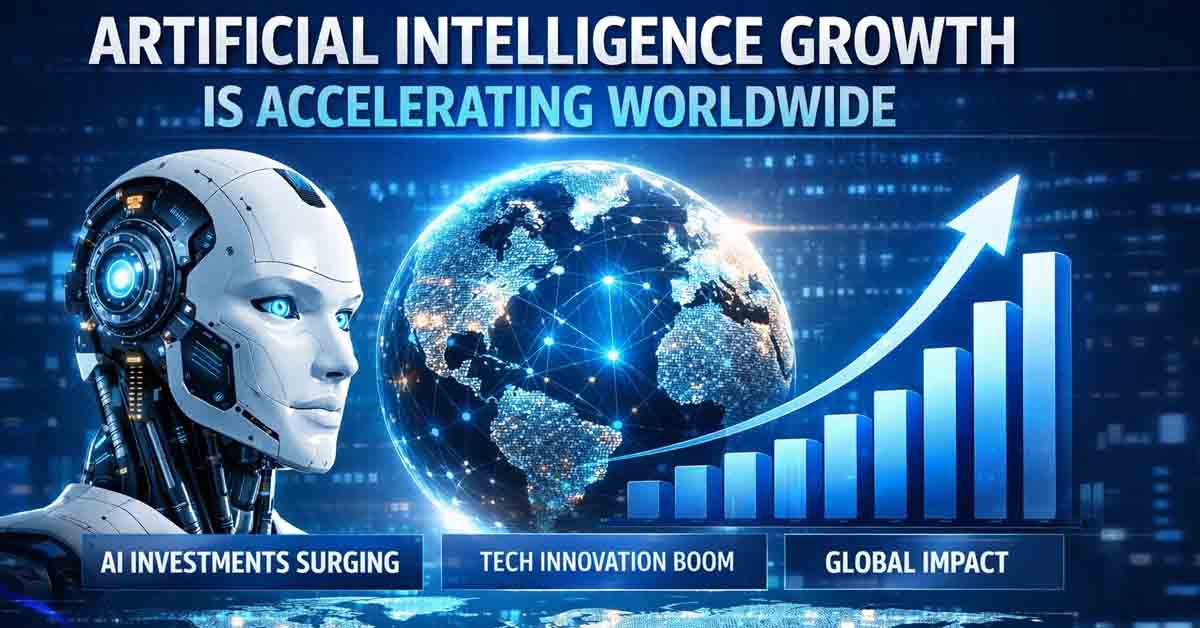
Artificial intelligence growth is happening faster than any previous technological revolution. What once seemed experimental has now become a core driver of global economic and digital transformation. Businesses, governments, and consumers are increasingly relying on AI to automate tasks, analyze data, and improve decision-making at scale.
The rapid expansion of artificial intelligence is not accidental. It is the result of several powerful forces converging at the same time.
What Is Driving Artificial Intelligence Growth?
One of the primary drivers of artificial intelligence growth is the massive increase in digital data. Every online interaction, transaction, sensor, and connected device generates information. AI systems depend on this data to learn patterns, improve accuracy, and adapt to real-world scenarios.
Another major factor is computing power. Advances in GPUs, cloud infrastructure, and specialized AI hardware have made it possible to train large models faster and deploy them globally. These improvements allow organizations to use AI at a scale that was impossible just a few years ago.
Investment is also fueling artificial intelligence growth. Governments and private companies are investing billions in AI research, development, and infrastructure. This funding accelerates innovation and helps move AI solutions from research labs into everyday applications.
Open-source frameworks and improved algorithms further support this growth. Developers now have access to powerful AI tools that reduce development time and lower technical barriers.
Artificial Intelligence Growth and the Global Economy
The economic impact of artificial intelligence growth is significant. Analysts estimate that AI could add trillions of dollars to the global economy over the next decade.
Businesses are using AI to automate repetitive work, optimize supply chains, and improve productivity. AI-powered analytics help companies make faster and more accurate decisions, leading to increased efficiency and revenue growth.
In manufacturing and agriculture, predictive maintenance and precision monitoring systems reduce waste and downtime. These AI-driven solutions allow organizations to operate more sustainably while increasing output.
Industry Transformation Through AI
Artificial intelligence growth is transforming nearly every major industry.
In healthcare, AI assists with diagnostics, medical imaging, personalized treatment plans, and drug discovery. These tools help medical professionals detect diseases earlier and improve patient outcomes.
The financial sector uses AI for fraud detection, risk management, algorithmic trading, and customer personalization. AI’s ability to process large datasets in real time makes it invaluable in modern finance.
Transportation and logistics rely on AI for route optimization, traffic management, and autonomous vehicle development. These systems aim to improve safety, efficiency, and fuel usage.
Social and Ethical Challenges of Artificial Intelligence Growth
Despite its benefits, artificial intelligence growth also introduces challenges.
Workforce disruption is a major concern. While AI automates certain roles, it also creates demand for new skills. Managing this transition responsibly is essential to prevent economic inequality.
Ethical issues such as bias, transparency, and data privacy remain critical. AI systems can reflect biases present in training data, making fairness and accountability key priorities.
Governments and international organizations are developing regulatory frameworks to guide the ethical use of AI. These policies aim to balance innovation with public safety and trust.
The Future of Artificial Intelligence Growth
Artificial intelligence growth shows no signs of slowing. As AI becomes more integrated into daily life, its influence on society and global systems will continue to expand.
The future of AI depends on responsible development, transparent governance, and thoughtful regulation. When managed correctly, artificial intelligence has the potential to deliver long-term benefits across industries and societies worldwide. Get More News