
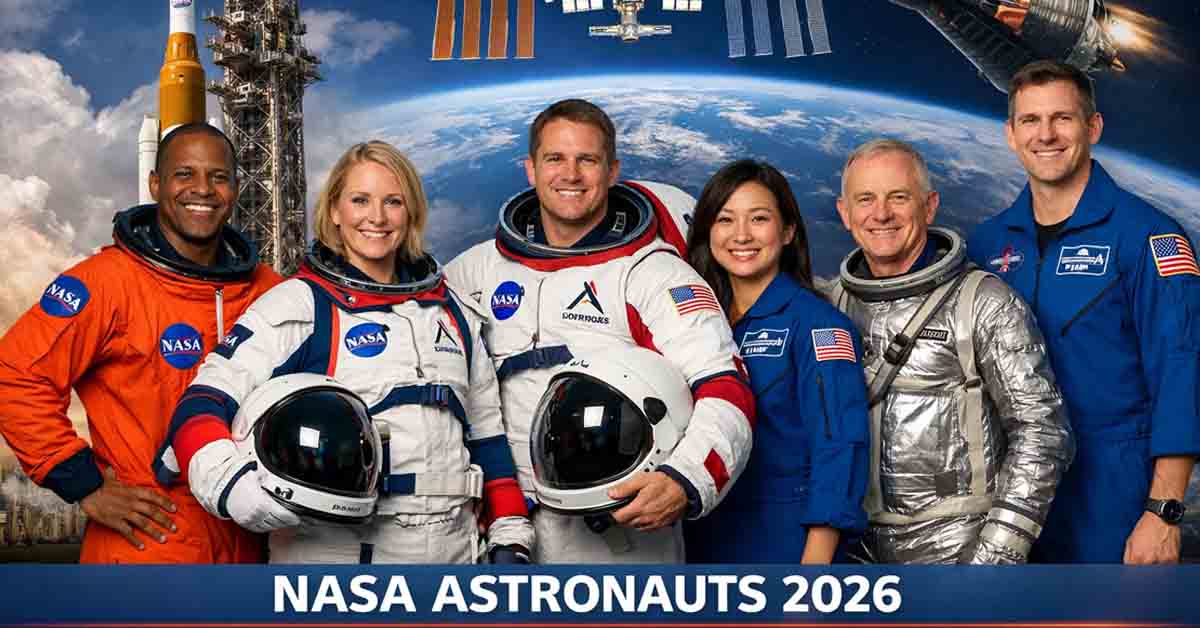
NASA astronauts remain at the forefront of global space exploration in 2026, balancing ongoing missions aboard the International Space Station (ISS) with preparations for humanity’s return to the Moon under the Artemis Program. As NASA advances toward deeper space exploration, today’s astronauts build on decades of experience shaped by earlier programs like Mercury, Gemini, and Apollo.
Current NASA Astronaut Missions in 2026
As of early 2026, NASA continues to manage active crews aboard the ISS, where astronauts conduct long-duration scientific research, technology testing, and Earth observation. These missions play a critical role in understanding how the human body adapts to extended time in microgravity, knowledge that is essential for future lunar and Mars missions.
NASA has also overseen recent crew rotations and emergency preparedness procedures, reinforcing the agency’s focus on astronaut safety and mission resilience.
Artemis Program: Returning Humans to the Moon
The Artemis Program represents NASA’s most ambitious human spaceflight initiative since Apollo. Its primary objective is not only to return astronauts to the Moon but to establish a sustainable human presence that can support future missions to Mars.
Key Artemis missions include:
- Artemis I: Successfully completed an uncrewed lunar test flight, validating the Space Launch System and Orion spacecraft.
- Artemis II: Planned as the first crewed mission to orbit the Moon, testing life-support systems and deep-space navigation.
- Artemis III: Expected to land astronauts near the Moon’s south pole, an area believed to contain water ice critical for long-term exploration.
The Moon’s south pole is strategically important due to its permanently shadowed regions, potential water resources, and extended periods of sunlight suitable for power generation.
New NASA Astronaut Candidates
In late 2025, NASA announced a new class of astronaut candidates currently undergoing intensive training. This training includes spacecraft systems, robotics, spacewalking techniques, and survival skills, ensuring readiness for both orbital and lunar missions.
The Mercury 7: America’s First Astronauts
NASA’s human spaceflight legacy began with Project Mercury (1958–1963). The original Mercury 7 astronauts proved that humans could survive and operate in space, laying the groundwork for all future missions.
Notable members include:
- Alan Shepard, the first American in space
- John Glenn, the first American to orbit Earth
- Sally Ride, the first American woman in space
- Neil Armstrong, the first human to walk on the Moon during Apollo 11
Their missions established essential flight, reentry, and recovery techniques still used today.
Why NASA Astronauts Still Matter
From the Mercury era to Artemis, NASA astronauts represent scientific progress, international cooperation, and technological innovation. Their work supports advancements in medicine, materials science, communications, and planetary exploration, benefiting life on Earth while expanding humanity’s reach into space. news.tempemailnow.com