
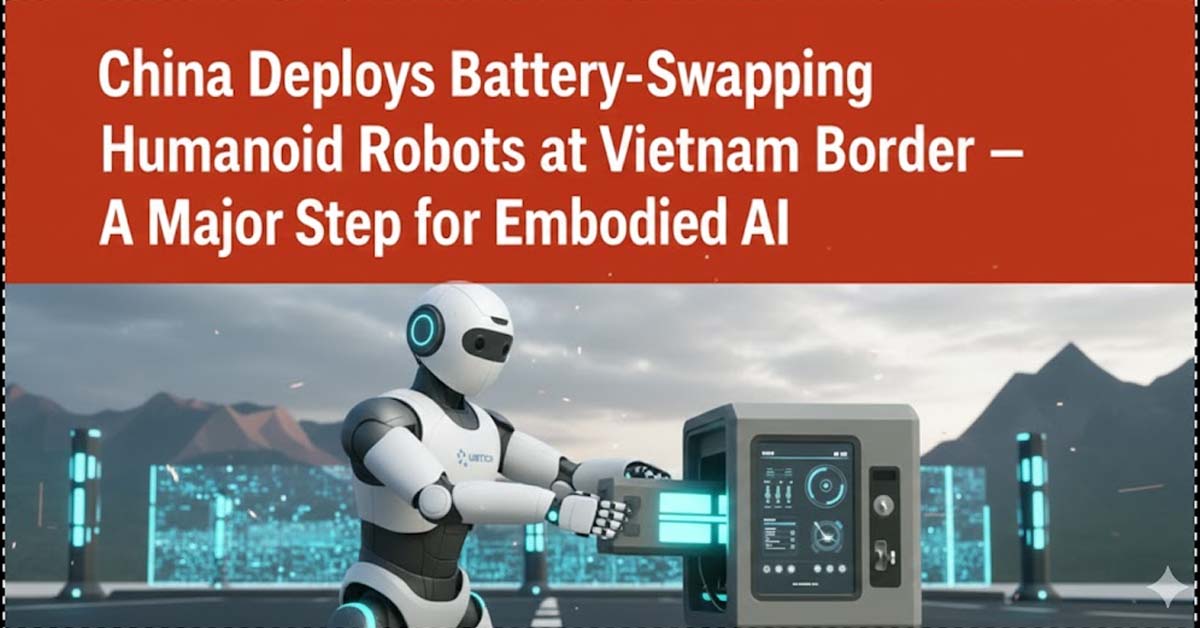
China has officially begun deploying China battery-swapping humanoid robots for real-world government operations, marking a major milestone in the country’s push toward mass adoption of embodied AI.
The robots, built by UBTech Robotics, are being tested for patrol, inspection, and logistics tasks along the border region facing Vietnam. This rollout follows China’s broader strategy to integrate advanced robotics into public service, manufacturing, and security sectors.
For readers new to AI developments, you can also explore What Is Elon Musk’s Grok AI? — another major advancement in the global AI race.
🤖 Meet Walker S2 — China’s Battery-Swapping Humanoid Robot
The featured machine in this program is the Walker S2, part of the new generation of China battery-swapping humanoid robots, designed for continuous, autonomous operation without human intervention.
Key Capabilities
Self-battery swapping:
Walker S2 can walk to a docking station, eject its depleted battery, and insert a new one — all in under 3 minutes.
24/7 duty cycle:
Because it doesn’t wait for charging, this China battery-swapping humanoid robot can work round-the-clock.
Autonomous navigation:
It moves independently, avoids obstacles, and follows patrol or inspection routes.
Industrial-grade hardware:
Engineered to operate in both government facilities and industrial environments, including factories and logistics hubs.
UBTech calls this a major breakthrough in full-cycle autonomous robotics, removing one of the biggest barriers to practical humanoid robots — downtime.
📍 Where China Is Deploying These Robots
The first deployment zone is Fangchenggang, a coastal city bordering Vietnam.
These China battery-swapping humanoid robots are currently used for:
- Border-crossing guidance
- Crowd flow management
- Logistics assistance
- Security inspections
- Supporting high-traffic checkpoint operations
Local authorities report that these robots improve operational speed and reduce heavy manual workloads during peak periods.
🏭 Factories Are Next — BYD, Geely & Foxconn Already Testing
Outside the border program, China is rapidly integrating humanoid robotics into large industrial systems:
- EV manufacturing lines
- Consumer electronics production
- Logistics and warehouse operations
Major companies including BYD, Geely, and Foxconn are testing Walker S2 units for assembly-line support, routine quality inspections, and repetitive precision tasks.
UBTech aims to deliver 500+ industrial humanoid robots by the end of 2025, with larger-scale deployment planned in the following years.
📈 Why This Rollout Matters for Embodied AI
The deployment of China battery-swapping humanoid robots is one of the largest real-world humanoid robot rollouts ever recorded. It reflects three major global trends:
1. Embodied AI is becoming operational
Robots are graduating from labs into real-world, everyday use.
2. China aims to lead the humanoid robotics industry
With strong government backing, China is investing heavily in mass manufacturing and industrial AI integration.
3. Public-sector automation is accelerating
Border management, inspections, and logistics are among the first sectors undergoing rapid automation.
Experts predict humanoid robots may become as common as drones or security cameras within the next decade.
📰 Final Summary
China’s deployment of China battery-swapping humanoid robots — led by the Walker S2 model — marks a new era in robotics and autonomous AI systems.
This is not just a demonstration; it is a full operational rollout driving humanoid robots directly into government, factory, and logistics workflows. News source
To learn more about our mission and reporting approach, visit the About Page.



1 thought on “China Battery-Swapping Humanoid Robots Deployed at Vietnam Border — A Major Step for Embodied AI”