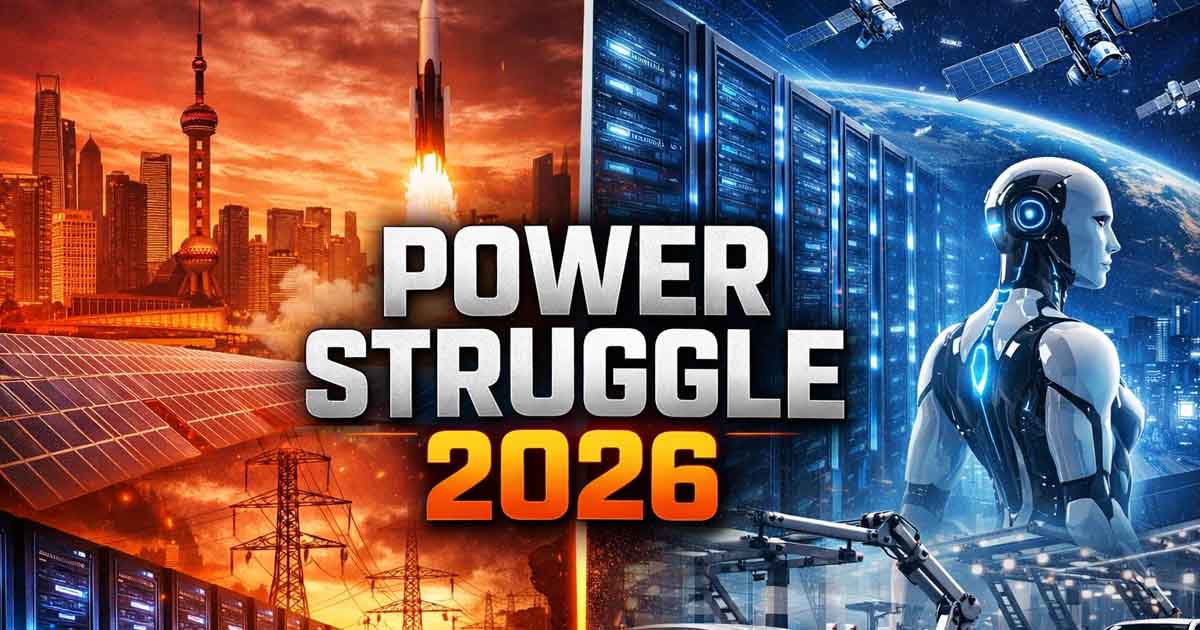
(TempWire News) – China vs Elon Musk technological rivalry defines the global technology narrative in 2026, as competition between China’s state-backed industrial ecosystem and Elon Musk’s private technology ventures intensifies across artificial intelligence, robotics, electric vehicles, and space infrastructure.
What was once a race for innovation has now evolved into a strategic battle for long-term technological leadership, with implications extending far beyond commercial markets.
China vs Elon Musk Technological Rivalry in AI and Energy Infrastructure
Artificial intelligence leadership in 2026 is increasingly determined by access to large-scale energy and computing infrastructure. Elon Musk has publicly acknowledged that China’s massive electricity generation capacity gives it a significant advantage in the global AI race.
China’s total power output is estimated to be nearly three times that of the United States, enabling large-scale AI training even under hardware and chip supply constraints. While Western nations focus on advanced semiconductor controls, China continues expanding solar power, battery storage, and grid-scale energy systems designed to support high-density data centers.
Musk recently revealed that securing grid access for a one-gigawatt AI supercluster in the United States required nearly a year of coordination, highlighting infrastructure bottlenecks that contrast sharply with China’s rapid deployment capabilities.
Robotics Emerges as the Next Major Battleground
The China vs Elon Musk technological rivalry has expanded into humanoid robotics, widely viewed as the next transformative industry. Musk has repositioned Tesla’s long-term strategy toward robotics, predicting that humanoid robots could surpass the economic value of the automotive sector.
However, Chinese robotics manufacturers have rapidly scaled production. In 2025, Chinese firms accounted for a significant share of global humanoid robot shipments, driven by aggressive pricing and manufacturing efficiency. By 2026, these companies are delivering units at prices that undercut Western competitors, accelerating adoption across industrial and service sectors.
Tesla has responded by reallocating factory resources and slowing legacy vehicle production to prioritize its humanoid robot program.
Electric Vehicle Market Confirms China’s Manufacturing Advantage
Electric vehicles remain a core element of the China vs Elon Musk technological rivalry. In 2025, Chinese automaker BYD surpassed Tesla to become the world’s largest EV seller, delivering millions of vehicles globally.
While Tesla increasingly focuses on autonomous systems, robotics, and AI platforms, Chinese manufacturers are doubling down on mass-market EV expansion. New affordable models introduced in 2026 aim to solidify China’s dominance across Asia, Latin America, and emerging markets.
This divergence signals a shift in strategy rather than a retreat, with Tesla betting on future technologies while China consolidates current market leadership.
Space and Satellite Infrastructure Enter the Competition
Space has become a strategic extension of the technological rivalry. Satellite networks are no longer limited to communications; they are evolving into platforms for data processing, navigation, and AI computation.
China has announced plans for ultra-large satellite constellations consisting of tens of thousands of satellites, significantly exceeding existing commercial networks. In parallel, proposals for space-based AI data centers indicate ambitions to move computing infrastructure beyond Earth’s surface.
Following close orbital encounters with Chinese satellites, SpaceX has initiated satellite repositioning efforts to enhance space safety and collision avoidance, underscoring rising congestion in low-Earth orbit.
Why This Rivalry Matters Globally
The China vs Elon Musk technological rivalry is not limited to competition between companies or nations. It reflects a broader shift in how technological power is built and sustained.
Key factors shaping the outcome include:
- Energy availability for AI computation
- Manufacturing scale and cost efficiency
- Control over satellite and orbital infrastructure
- Speed of deployment versus regulatory friction
Analysts note that future technological leadership will increasingly depend on integrated ecosystems capable of rapid scaling rather than isolated breakthroughs.
Conclusion
The China vs Elon Musk technological rivalry in 2026 marks a critical turning point in global technology competition. As artificial intelligence, robotics, electric vehicles, and space-based systems increasingly converge, technological leadership is shifting toward those who can scale infrastructure rapidly and deploy innovation at industrial levels.
Rather than isolated breakthroughs, long-term dominance now depends on integrated ecosystems capable of sustaining massive energy consumption, large-scale manufacturing, and continuous technological deployment. The strategic decisions made during this period are expected to shape the global technology order for decades, influencing how innovation, automation, and digital infrastructure evolve worldwide.
Source: Global Times