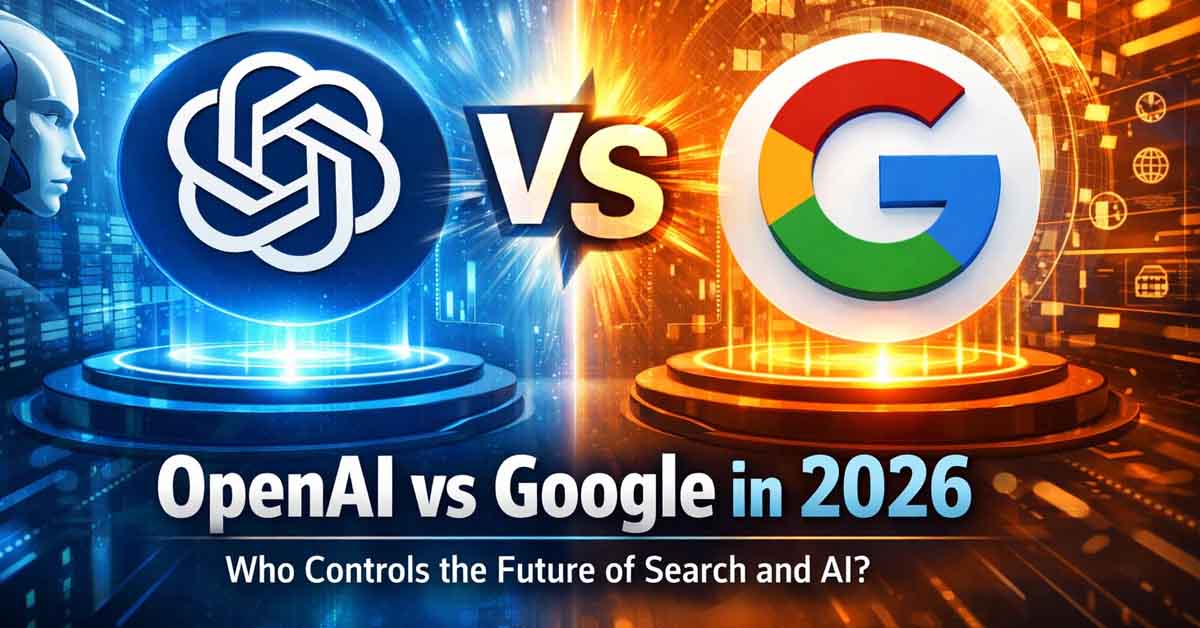
OpenAI vs Google in 2026 has become one of the most important technology rivalries shaping how people discover information online. What began as an AI research race has evolved into a battle over search, data access, platform trust, and control of the digital knowledge ecosystem.
Both companies are redefining how users interact with information — but they are taking very different approaches.
How Google’s Search Model Is Evolving
For decades, Google dominated information discovery through its traditional search engine. In 2026, that dominance is no longer based solely on ranking webpages.
Google is now integrating AI deeply into search results:
- AI-generated summaries and overviews
- Contextual understanding of intent
- Entity-based results rather than keyword-based listings
This evolution allows Google to answer queries directly, often without requiring users to click external links. While this improves user convenience, it also changes how publishers gain visibility.
Google’s advantage remains its scale — massive data, indexing infrastructure, and long-established trust.
OpenAI’s Disruptive Search Approach
OpenAI has taken a fundamentally different path. Instead of indexing the web in the traditional sense, OpenAI focuses on conversational, intent-driven responses powered by large language models.
In 2026, OpenAI’s search-style experiences emphasize:
- Natural language interaction
- Multi-step reasoning
- Context retention across queries
This approach shifts search from finding links to receiving synthesized answers. For users, this feels faster and more intuitive. For publishers, it raises questions about attribution, traffic, and content sourcing.
Data Control and Trust Differences
A critical factor in OpenAI vs Google in 2026 is data control.
Google:
- Crawls and indexes public web content
- Relies heavily on publisher ecosystems
- Uses structured data and entities for validation
OpenAI:
- Trains models on licensed, created, and public data
- Provides answers without always surfacing sources prominently
- Operates as a closed conversational interface
These differences affect how creators and publishers engage with each platform. Google still sends traffic, even if reduced. OpenAI prioritizes response quality over referral volume.
Impact on Publishers and Content Creators
The rivalry between OpenAI and Google has direct consequences for publishers.
Under Google’s model:
- Authority sites can still earn visibility
- Structured, trustworthy content is referenced
- Entity recognition matters more than keywords
Under OpenAI’s model:
- Content influences answers, not rankings
- Attribution is less predictable
- Brand visibility depends on recognition, not clicks
This forces publishers to rethink success metrics. Visibility is no longer measured only by traffic, but by presence within AI-driven responses.
Who Has the Advantage in 2026?
In the OpenAI vs Google in 2026 comparison, neither side has absolute control — yet.
Google’s strengths:
- Global infrastructure
- Deep integration with Android, Chrome, and Ads
- Strong publisher relationships
OpenAI’s strengths:
- Rapid innovation
- Conversational user experience
- Strong adoption among professionals and developers
Google controls distribution. OpenAI controls interaction style.
The Future of Search Is Hybrid
Rather than replacing Google, OpenAI is reshaping expectations. Users increasingly want:
- Direct answers
- Context-aware responses
- Less friction
Google is adapting by embedding AI into search, while OpenAI continues refining conversational discovery. The future likely combines both models.
Search in 2026 is no longer a single platform — it is an ecosystem of AI-powered interfaces.
What This Means Going Forward
For brands, publishers, and platforms, OpenAI vs Google in 2026 signals a long-term shift:
- Authority matters more than optimization
- Trust outweighs volume
- Being understood by AI systems is as important as ranking
Those who adapt early will remain visible across both ecosystems.
Final Thoughts
OpenAI vs Google in 2026 is not about who replaces whom — it is about who shapes how information is accessed. Google still dominates discovery, but OpenAI is redefining interaction.
The future of search belongs to platforms that combine trust, intelligence, and clarity — and the competition between these two giants is accelerating that transformation. news.tempemailnow.com