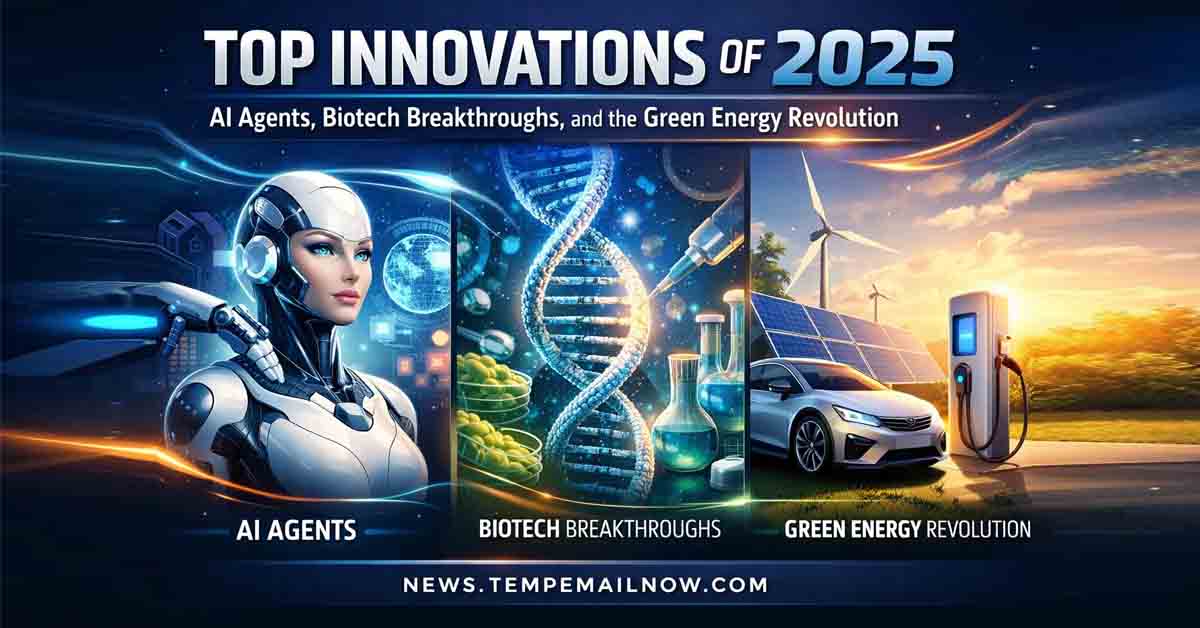
2025 has emerged as a defining year for global innovation. Technologies that once existed only in research labs have now matured into scalable, real-world systems reshaping industries, healthcare, energy, and space exploration.
A powerful convergence of Artificial Intelligence, biotechnology, sustainable energy, and commercial aerospace is redefining how societies function and how businesses operate. Below are the most impactful innovations of 2025 that are actively shaping the future.
AI in 2025: From Assistants to Autonomous Agents
Artificial Intelligence has evolved far beyond chatbots and productivity tools. In 2025, AI systems operate as autonomous agents, capable of making decisions and managing complex workflows independently.
Agentic AI workflows are now handling supply chain optimization, financial reconciliation, customer support automation, and enterprise operations with minimal human supervision. This shift has significantly reduced operational costs while increasing efficiency.
Multimodal AI models such as DeepSeek R1 and Claude 4 can process text, audio, and visual data simultaneously. These systems demonstrate near human-level contextual understanding and real-time reasoning.
To address the rise of AI-generated content, generative watermarking has become an industry standard. Invisible watermarks embedded in AI outputs help verify authenticity and combat deepfakes across digital platforms.
Biotech & Healthcare: Precision Medicine Takes Center Stage
Biotechnology in 2025 is focused on precision medicine, targeting the biological root causes of disease rather than symptoms.
One of the most notable breakthroughs is the FDA approval of VIZZ, an aceclidine-based eye drop developed by LENZ Therapeutics. Approved in mid-2025, VIZZ temporarily corrects presbyopia, allowing users to regain near vision for up to 10 hours without glasses.
GLP-1 medications, originally designed for diabetes and weight management, are now being studied for brain health. Clinical trials show promising results in reducing neuroinflammation, opening new treatment pathways for Alzheimer’s and Parkinson’s disease.
Synthetic biology has also introduced engineered living therapeutics—modified cells that reside inside the patient and produce medicine on demand. These biological “micro-factories” are redefining how chronic illnesses are treated.
Sustainable Energy: Scaling the Green Transition
With climate regulations tightening globally, innovation in 2025 is focused on scaling clean energy solutions efficiently.
Structural battery composites now integrate energy storage directly into vehicles and aircraft structures, reducing weight and increasing range. These batteries turn chassis and wings into functional energy systems.
Green nitrogen fixation technologies are replacing the carbon-intensive Haber-Bosch process, significantly lowering emissions from fertilizer production and supporting a more sustainable global food supply.
Osmotic power, also known as blue energy, has become commercially viable due to advances in membrane technology. Energy generated from salinity differences between freshwater and seawater is emerging as a reliable renewable source.
Aerospace: The Commercial Space Economy Accelerates
Space exploration in 2025 is increasingly driven by private companies rather than governments alone.
The Vera C. Rubin Observatory in Chile began full operations using the world’s largest digital camera at 3,200 megapixels. The observatory is mapping the night sky in unprecedented detail to study dark matter and cosmic evolution.
Private lunar missions have also reached new milestones. Companies like Firefly Aerospace successfully completed soft lunar landings, accelerating the development of a sustainable commercial lunar economy.
Blue Origin’s NS-31 mission made history as the first all-female commercial spaceflight, signaling progress toward broader inclusion in space exploration.
Most Innovative Companies of 2025
Industry rankings highlight companies that have successfully scaled innovation:
- ServiceNow – Ranked the most innovative company of 2025 for digital workflow automation and agentic AI leadership
- NVIDIA – The backbone of global AI infrastructure through high-performance semiconductor dominance
- Tesla & Amazon – Recognized for advancements in autonomous robotics, logistics, and automation
Final Takeaway
Innovation in 2025 is defined by integration and execution, not experimentation. Autonomous AI, precision biotech, clean energy systems, and commercial spaceflight are no longer future concepts—they are reshaping the global economy today. About TempWire News