
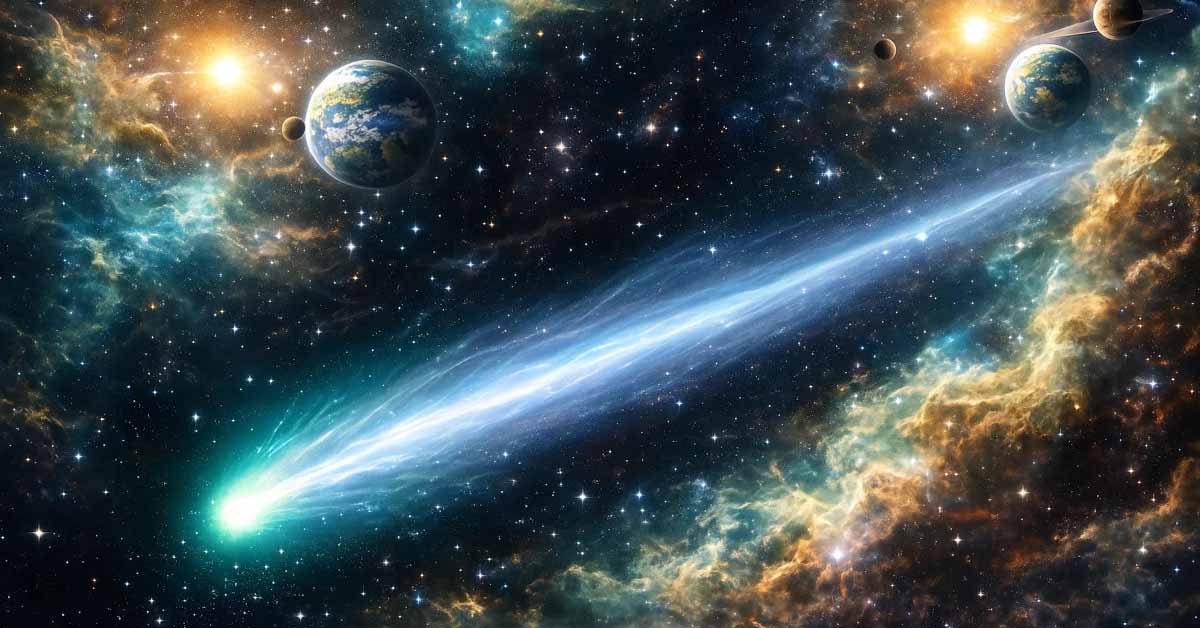
Interstellar comet 3I/ATLAS has been confirmed as the third known object from beyond our solar system ever detected passing through the Sun’s neighborhood. The interstellar comet 3I/ATLAS was discovered on July 1, 2025, by the NASA-funded ATLAS survey telescope in Chile.
Unlike ordinary comets that originate within the solar system, the interstellar comet 3I/ATLAS is traveling on an unbound, hyperbolic trajectory. This means it is not gravitationally bound to the Sun and will eventually leave the solar system permanently. Its extreme speed, measured at more than 130,000 miles per hour relative to the Sun, confirmed its interstellar origin.
Observations show that the interstellar comet 3I/ATLAS is a true comet with an icy nucleus surrounded by a cloud of gas and dust known as a coma, along with a faint tail. This classification distinguishes it from interstellar asteroids and confirms the presence of volatile materials.
Data collected from the James Webb Space Telescope and other observatories reveal that interstellar comet 3I/ATLAS is unusually rich in carbon dioxide. Scientists also detected water ice, cyanide compounds, and traces of nickel vapor. These chemical signatures provide rare insight into the formation of planetary systems beyond our own.
Astronomers estimate that the solid nucleus of interstellar comet 3I/ATLAS is less than 5.6 kilometers in diameter, while its coma stretches hundreds of thousands of kilometers across. The large size of the coma makes the comet easier to observe using advanced telescopes.
Interstellar comet 3I/ATLAS made its closest approach to the Sun on October 29, 2025, passing between the orbits of Earth and Mars. It later passed closest to Earth on December 19, 2025, at a safe distance of approximately 270 million kilometers.
The interstellar comet 3I/ATLAS is not visible to the naked eye. However, astronomers report that it can be observed using small ground-based telescopes in the pre-dawn sky. It is currently located in the constellation Leo and is expected to remain observable until spring 2026.
Astronomers around the world continue to study interstellar comet 3I/ATLAS using space-based observatories such as the Hubble Space Telescope and the James Webb Space Telescope. Scientists say this rare visitor offers a unique opportunity to study material from another star system and compare it directly with objects formed within our own solar system. more know