
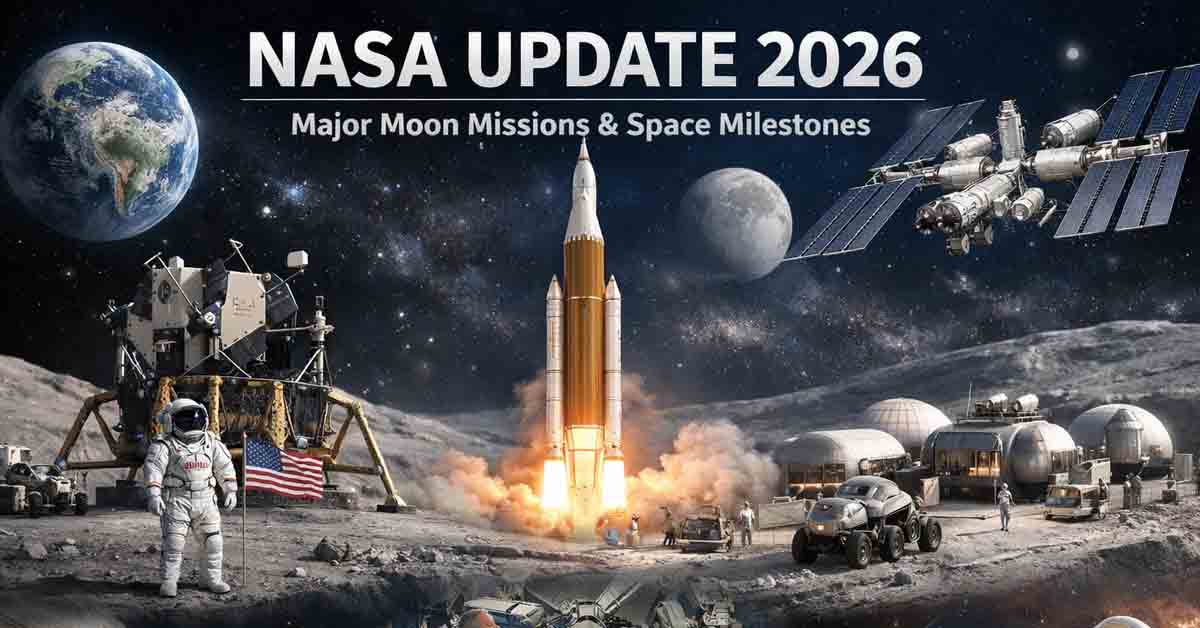
NASA update 2026 highlights a pivotal year for space exploration, with ambitious lunar missions, new scientific launches, and important policy developments shaping the agency’s roadmap. As NASA continues its long-term goal of returning humans to the Moon and preparing for future Mars exploration, 2026 stands out as a critical transition year.
This overview breaks down the most important NASA plans and confirmed developments expected throughout 2026.
Artemis Program: Returning Humans to the Moon
One of the most significant elements in the NASA update 2026 is progress under the Artemis program.
Artemis II, NASA’s first crewed mission around the Moon since the Apollo era, is scheduled for early 2026. The mission will send four astronauts aboard the Space Launch System (SLS) rocket and Orion spacecraft on a lunar flyby. This mission is designed to validate life-support systems, navigation, and deep-space operations with humans onboard.
Following Artemis II, Artemis III remains targeted for late 2026. This mission aims to land astronauts on the lunar surface for the first time in over five decades. While the schedule depends on technical readiness—particularly the lunar landing system and heat shield testing—NASA continues to identify Artemis III as a cornerstone of its Moon-to-Mars strategy.
In parallel, NASA is supporting commercial and international lunar payload missions, enabling scientific instruments from NASA and partner agencies to reach the Moon’s surface. These robotic missions will collect data on lunar geology, radiation, and surface conditions ahead of long-term human presence.
Space Science Missions Launching in 2026
Beyond lunar exploration, the NASA update 2026 includes several major science initiatives.
The Sun Radio Interferometer Space Experiment (SunRISE) is planned for launch in mid-2026. This mission will study how solar storms form and evolve, improving forecasts of space weather events that can disrupt satellites, power grids, and communications on Earth.
NASA also continues operations aboard the International Space Station (ISS). Early 2026 spacewalks are scheduled for station maintenance, camera upgrades, and system inspections, ensuring continued research operations in low Earth orbit.
In planetary science, NASA will collaborate with international and private missions exploring Mars and Venus. These partnerships expand scientific reach while sharing costs and expertise across agencies.
Budget and Policy Developments
A notable aspect of the NASA update 2026 involves funding discussions. Proposed budget adjustments may affect long-term projects, including the Mars Sample Return mission. While core Artemis objectives remain a priority, NASA is evaluating how budget changes influence future mission timelines and partnerships.
Commercial partnerships also remain central to NASA’s strategy. SpaceX is expected to conduct critical Starship orbital refueling demonstrations in 2026, a key requirement for supporting future lunar landings and deep-space missions.
Key Astronomical Events in 2026
NASA’s research efforts align with several high-interest astronomical events in 2026.
A total lunar eclipse, often referred to as a “blood moon,” is expected to be visible across large parts of North America in March 2026. Events like this provide opportunities for public engagement and scientific observation.
Additionally, Comet 3I/ATLAS is projected to pass through the outer solar system during 2026, offering astronomers a rare chance to study long-period comet behavior.
Why NASA Update 2026 Matters
The NASA update 2026 reflects a broader shift in space exploration. The agency is balancing human exploration, robotic science, and commercial collaboration while preparing for deeper missions beyond the Moon. These efforts not only advance scientific understanding but also influence technology development, global partnerships, and future space economies.
As 2026 unfolds, NASA’s progress will play a major role in defining the next decade of space exploration. More News About Nasa