
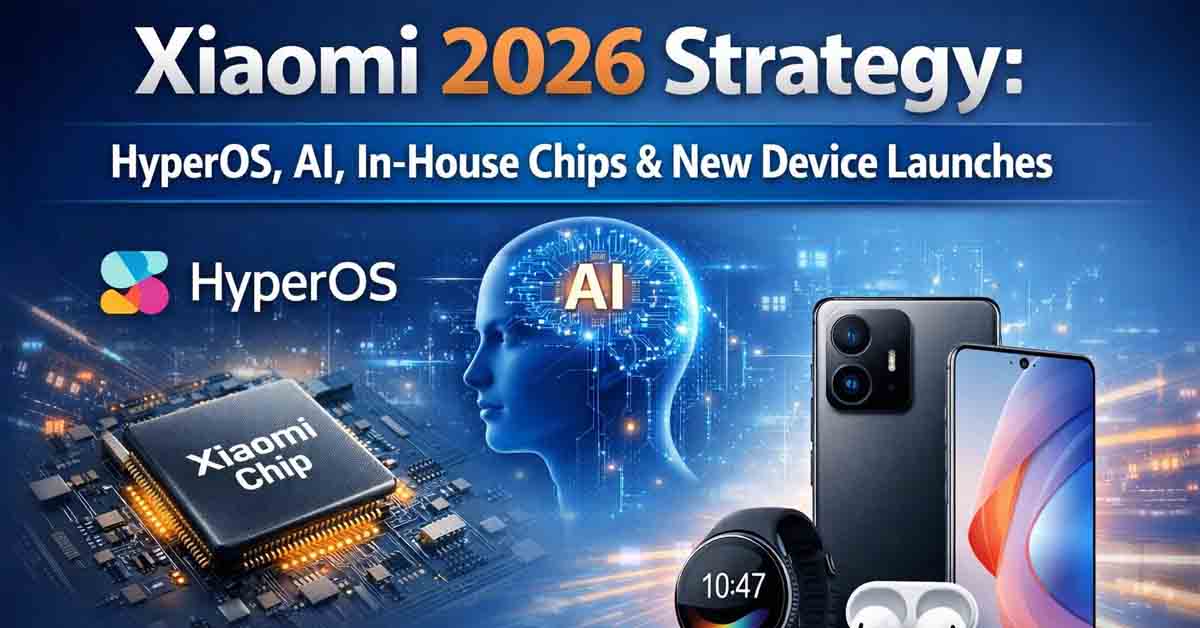
Xiaomi has outlined its long-term roadmap for 2026, revealing a strategy focused on platform independence, artificial intelligence, and deeper ecosystem integration. While the company has not announced a single global “Xiaomi 2026 launch event,” recent product releases, executive statements, and technology investments provide a clear picture of where Xiaomi is heading.
The Xiaomi 2026 strategy highlights a shift away from isolated hardware launches toward a tightly connected ecosystem built on proprietary software, in-house technologies, and AI-driven experiences across devices.
Xiaomi 2026 Strategy: Ecosystem, AI, and Platform Independence
At the core of the Xiaomi 2026 strategy is the vision of a unified ecosystem that connects smartphones, wearables, smart home devices, displays, and vehicles. Xiaomi aims to deliver consistent user experiences across this ecosystem by strengthening coordination between hardware, software, and artificial intelligence.
A key pillar of this approach is technological self-reliance. Xiaomi is increasing its focus on developing proprietary chipsets, operating systems, and AI systems to reduce dependence on third-party suppliers. This allows the company to optimize performance, improve long-term software support, and gain tighter control over its product roadmap.
HyperOS and AI Integration in 2026
HyperOS plays a central role in Xiaomi’s ecosystem strategy. Introduced as a replacement for MIUI, HyperOS is designed to unify Xiaomi’s smartphones, tablets, wearables, TVs, and smart home products under a single software framework.
The upcoming HyperOS 3.0, expected in early 2026 and based on Android 16, is anticipated to bring system-level performance improvements, stronger privacy controls, and deeper AI integration. AI features are expected to enhance automation, cross-device interaction, and contextual intelligence across Xiaomi products.
By expanding HyperOS across both flagship and select mid-range devices, Xiaomi aims to deliver a consistent software experience regardless of device category or price segment.
In-House Chips and Long-Term Hardware Control
Another major component of the Xiaomi 2026 strategy is the development of in-house chip technologies. Xiaomi has been investing in semiconductor research to improve efficiency, performance optimization, and hardware-software integration.
Custom silicon allows Xiaomi to fine-tune features such as AI processing, camera performance, power management, and device security. While third-party chipsets will continue to play a role, Xiaomi’s growing internal capabilities signal a long-term move toward greater platform independence.
Recent and Expected Xiaomi Product Launches
Several device launches in late 2025 and early 2026 reflect Xiaomi’s broader strategic direction:
- Xiaomi 17 Ultra (Leica Edition): A premium smartphone featuring a 1-inch Leica camera sensor, aimed at photography-focused users.
- Redmi Turbo 5 and Turbo 5 Pro: Performance-oriented mid-range smartphones expected to use MediaTek Dimensity processors.
- Xiaomi Watch 5 Series: A smartwatch lineup with upgraded health tracking, fitness metrics, and smart features.
- Xiaomi TV S Pro Mini LED 2026: A smart TV series using QD Mini LED technology, available in multiple screen sizes.
- Redmi Pad 2 Pro: A tablet designed for long-term software support and seamless integration within Xiaomi’s ecosystem.
These launches demonstrate Xiaomi’s focus on expanding its ecosystem beyond smartphones while maintaining competitive pricing across categories.
Research and Development Investment
To support its long-term goals, Xiaomi plans to invest approximately 200 billion yuan in research and development over the next five years. This investment will prioritize semiconductors, artificial intelligence, operating systems, and next-generation smart devices.
The scale of this R&D commitment reflects Xiaomi’s ambition to compete more directly with vertically integrated technology companies by strengthening control over core technologies.
Xiaomi 2026 Strategy in the Global Tech Landscape
The Xiaomi 2026 strategy places the company alongside other global technology brands that are emphasizing ecosystem control and AI-driven platforms. By expanding HyperOS, developing in-house chips, and integrating AI more deeply across devices, Xiaomi aligns with a broader industry shift toward vertically integrated ecosystems.
This strategy enables Xiaomi to improve performance optimization, security, and cross-device compatibility while reducing reliance on external suppliers. As competition intensifies in smartphones, wearables, and smart home products, Xiaomi’s roadmap signals a move toward long-term platform stability and ecosystem coherence.
What Xiaomi’s 2026 Roadmap Signals
Xiaomi’s 2026 roadmap marks a transition from standalone product development to a unified, AI-powered ecosystem strategy. By combining proprietary software, internal hardware development, and diversified device categories, the company aims to strengthen its position in the global consumer electronics market.
As Xiaomi continues to expand across smartphones, wearables, displays, and connected devices, the Xiaomi 2026 strategy reflects a broader industry trend toward intelligent, interconnected digital ecosystems driven by AI and platform integration. news.tempemailnow.com